
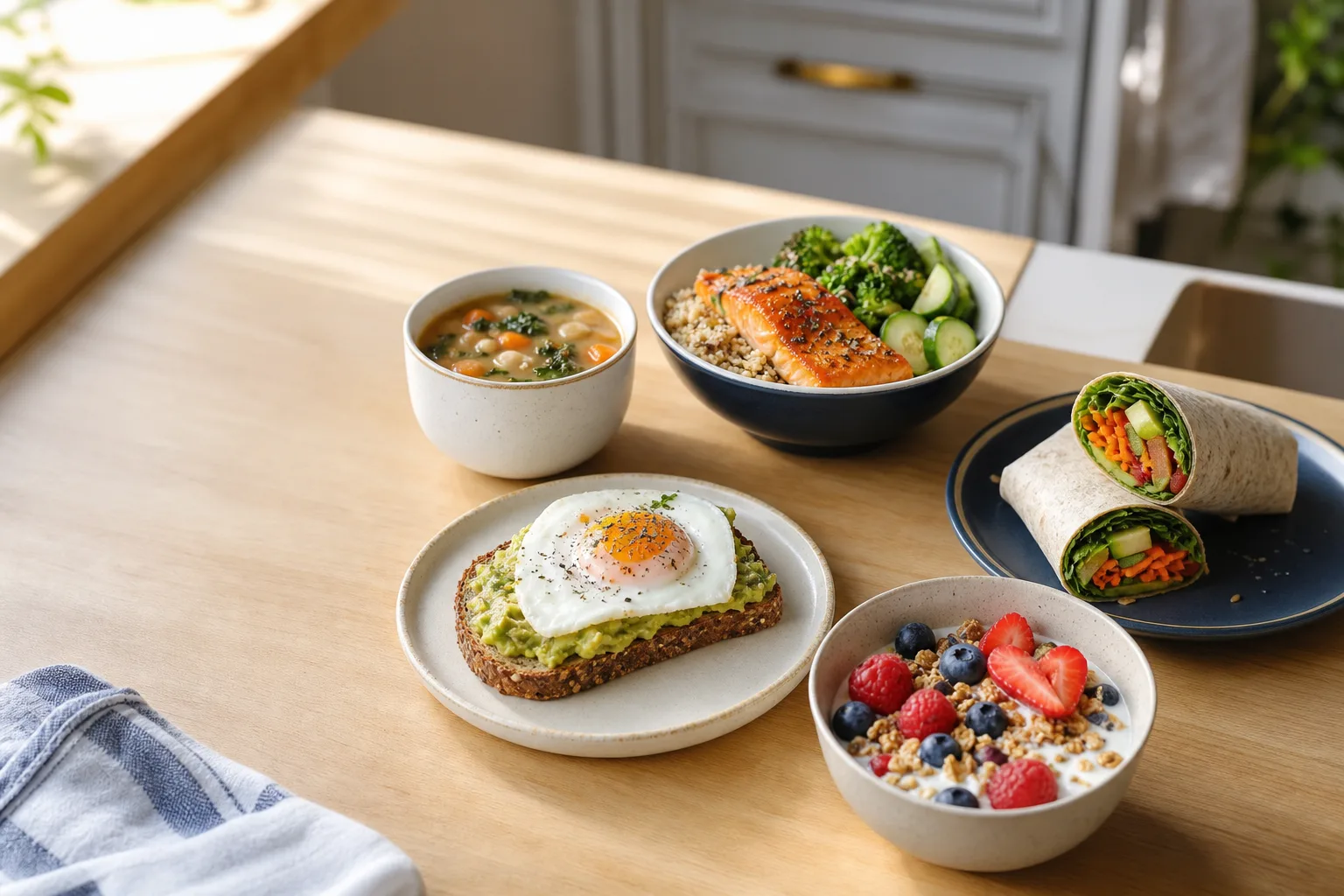
Short answer: Easy GLP-1 meals for busy weeknights use familiar ingredients, adjustable portions, and short preparation paths. Bowls, soups, wraps, toast, sheet-pan meals, and freezer portions can all fit the framework.
How to apply the short answer
The easiest meal is not always the one with the shortest recipe. A useful weeknight option also has ingredients you keep, equipment you understand, portions you can adjust, and leftovers you will actually use.
These twelve ideas are planning prompts rather than medical recommendations. Change ingredients for allergies, dietary preferences, budget, culture, and guidance from your care team.
Start with the easy GLP-1 recipes to place the article inside its main food-planning framework.
1–2. Rotisserie-style chicken bowl or tofu rice bowl
Combine a modest amount of prepared chicken or browned tofu with microwaveable or previously cooked rice, frozen vegetables, and a familiar sauce. Keep components separate until serving. Check labels and allergens on prepared foods, and follow safe handling guidance for cooked chicken and rice.
Turn this idea into one written decision before the week begins. Note the smallest useful version, a familiar alternative, and anything that must stay fixed because of an allergy, preference, budget, or food-safety rule. That makes easy weeknight meals: 1–2. rotisserie-style chicken bowl or tofu rice bowl a real planning tool instead of another standard to meet.
3–4. Salmon tray or white-bean tomato skillet
Roast a salmon portion beside a small tray of vegetables, or warm white beans with canned tomatoes, greens, and herbs. Both options use one cooking vessel and scale by portion. Serve with bread, grain, or potatoes according to preference and individual guidance.
Keep the portion adjustable at serving time. Store components separately when practical, serve a modest amount first, and keep the remainder safely chilled rather than placing the full recipe on the plate. In the context of easy weeknight meals: 3–4. salmon tray or white-bean tomato skillet, flexibility is a design feature, not a failure to follow the plan.
5–6. Egg and vegetable toast or yogurt savory bowl
Top whole-grain toast with egg and cooked vegetables, or use plain yogurt with cucumber, herbs, chickpeas, and crackers for a no-cook option. Choose pasteurized and safely stored dairy and eggs, and substitute for allergens rather than treating the named ingredients as essential.
Make the shopping list reflect the actual household. Check package sizes, choose ingredients that can appear in more than one meal, and give every perishable item a first use and a backup use. This is how easy weeknight meals: 5–6. egg and vegetable toast or yogurt savory bowl can reduce friction without creating an oversized refrigerator inventory.
For a connected kitchen example, continue with meal prep without food waste while the practical decision above is still in view.
7–8. Soup cup or turkey hummus roll-up
Heat a safely stored soup portion and add bread or fruit, or roll turkey, hummus, and vegetables in a tortilla. Prepared soups and deli foods vary in ingredients and labeling, so compare packages for allergens and any requirements already identified with a clinician.
Build a low-effort route into the plan. A prepared component, freezer portion, shelf-stable backup, or five-minute assembly can protect the week when time or appetite differs from what was expected. The aim of easy weeknight meals: 7–8. soup cup or turkey hummus roll-up is continuity, not a perfectly repeated schedule.
9–10. Shrimp couscous cup or lentil grain bowl
Quick-cooking couscous and thoroughly cooked shrimp can form one small meal; lentils, grain, vegetables, and dressing form another. Measure only what the household will use, cool leftovers promptly, and avoid leaving cooked seafood or grains at room temperature.
Treat storage as part of the recipe. Cool leftovers promptly, use shallow covered containers where appropriate, label dates, follow recognized storage guidance, and discard food when safety is uncertain. Good storage makes easy weeknight meals: 9–10. shrimp couscous cup or lentil grain bowl more useful while keeping convenience separate from guesswork.
11–12. Freezer meatballs or a snack-plate dinner
Reheat a labeled freezer portion of meatballs with vegetables and pasta, or assemble a plate from cheese or tofu, fruit, vegetables, crackers, and a dip. A snack-plate dinner still needs safe storage and allergen awareness; it is simply an assembly format.
Review the result without grading the person. Record what was useful, what remained, which package was too large, and which option was easy to repeat. Use those observations to simplify the next version of easy weeknight meals: 11–12. freezer meatballs or a snack-plate dinner rather than adding more rules or making outcome promises.
Put the framework through three real-life checks
The routine check: Ask where easy weeknight meals fits on the busiest ordinary day, not only on an ideal weekend. Identify the equipment, time, storage, and shopping step it requires. If the plan depends on a long preparation window that rarely exists, reduce the number of components or name a genuinely easier route. A strong plan should remain understandable when attention is limited.
The flexibility check: Start with “Choose three meals that share ingredients.” and “Keep two freezer or shelf-stable backups.,” then imagine that schedule, appetite, or household plans change. The food should still have a safe next use, and the person should still have an acceptable choice. Flexibility does not remove boundaries: allergens, sanitation, storage temperatures, clinician-provided instructions, and personal consent remain fixed.
The evidence check: Use “Use pre-cut or frozen produce when helpful.” as a prompt to separate observable kitchen facts from health assumptions. It is reasonable to record that a package was too large or a recipe was easy to reheat. It is not reasonable for a meal planner to infer a diagnosis, medication effect, or clinical outcome. Keep private wellness information out of marketing, analytics, affiliate decisions, and editorial performance reports.
Within “12 Easy GLP-1 Diet for Busy Weeknights,” one concrete application is the Turkey Hummus Pinwheels with Cucumber recipe, where the ingredients, portioning, substitutions, and storage notes can be evaluated in context.
A practical checklist
- Choose three meals that share ingredients.
- Keep two freezer or shelf-stable backups.
- Use pre-cut or frozen produce when helpful.
- Serve a modest first portion.
- Cool and label leftovers promptly.
Frequently asked questions
What makes a meal “GLP-1 friendly”?
GLP1DIET avoids that vague promise. These are ordinary, flexible meal ideas for adults using GLP-1 medications, not meals that change how a medication works or guarantee an outcome.
Can prepared foods be used?
Yes, when they fit preferences and individual guidance. Read ingredient, allergen, storage, and preparation labels rather than assuming every prepared food is interchangeable.
Do busy-night meals need meal prep?
No. Keep a mix of prepared components, freezer portions, and genuinely quick assemblies so the plan does not depend on a long weekend prep session.
Safety, evidence, and scope
Nothing in this approach to easy weeknight meals creates a required GLP-1 diet. The article supports adult meal organization while leaving symptoms, adequacy assessment, prescribing, treatment, and dosing outside the platform.
The review process distinguishes kitchen facts from clinical inference, checks cited evidence before publication, and keeps advertising, affiliate, analytics, and email systems away from private wellness records. For this page, that control is applied specifically to easy weeknight meals.
Editorial scope for easy weeknight meals: This adult general-wellness article is released only when its sources, claims, links, and any required reviewer identity satisfy the editorial workflow.
An easy GLP-1 meal for a busy weeknight uses a short method, familiar ingredients, a manageable portion, and a clear storage plan. The best fit is the meal that works within the actual time and cleanup available, not the recipe with the shortest marketing headline. Compare sheet-pan meals, bowls, quick skillets, assembled plates, and planned leftovers by active time, number of dishes, texture, storage, and household flexibility. Pick the busiest evening first. Choose one protein component, one produce component, and the simplest suitable cooking method.Choose an easy meal for a busy night
Compare the options with concrete criteria
Apply the guide to the next meal